
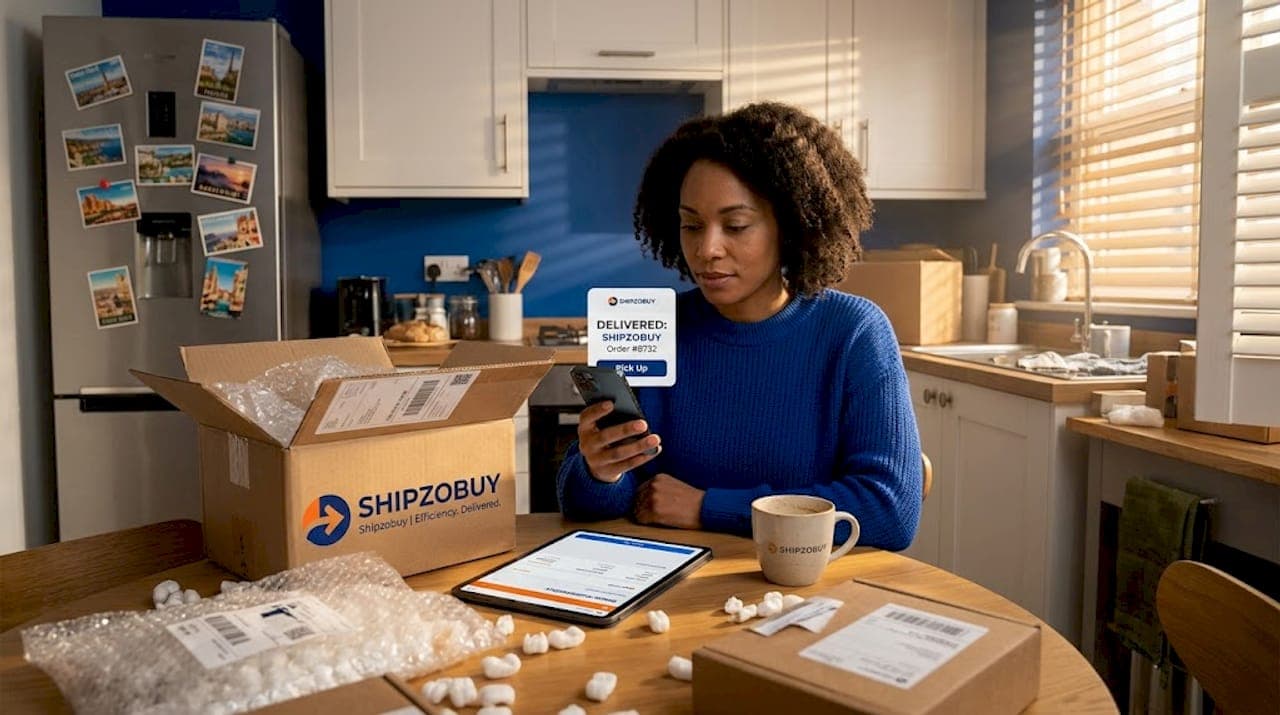
You click "Buy Now" on a stunning jacket from Taobao, and the excitement kicks in immediately. But here's what most shoppers don't realize: the quality of that jacket matters far less than what happens next. Shipping failures quickly erode trust and repeat purchase intent, which means the entire post-purchase experience, from tracking updates to package condition at your door, determines whether you ever shop internationally again. For anyone buying from Chinese marketplaces like Taobao, Tmall, and Weidian, understanding how logistics works isn't just useful knowledge. It's the difference between a smooth, satisfying experience and a frustrating ordeal that puts you off cross-border shopping for good.
Table of Contents
- Why logistics is more than delivery: The trust factor
- How cross-border logistics works for Chinese marketplaces
- Choosing logistics options: Speed, cost, and reliability
- Logistics as a growth engine: Volume, efficiency, and future trends
- The uncomfortable truth about logistics in cross-border shopping
- Looking for a seamless shipping experience?
- Frequently asked questions
Key Takeaways
| Point | Details |
|---|---|
| Trust is built post-purchase | Reliable logistics and visible tracking are as important as great deals for online shoppers. |
| Consolidation saves money | Combining multiple items into one shipment lowers costs and adds control for cross-border buyers. |
| Smart choices prevent hassles | Knowing your logistics options and deadlines helps you avoid delays and fees. |
| Scale brings innovation | Massive order volumes are driving new logistics technology and faster international delivery. |
Why logistics is more than delivery: The trust factor
Most shoppers think about logistics only when something goes wrong. A package arrives crushed, a tracking number stops updating, or a delivery misses its estimated window by two weeks. At that point, the product quality you spent hours researching becomes almost irrelevant. What sticks in your memory is the failure of the system that was supposed to bring it to you.
Logistics, in the true sense, covers far more than just moving a box from point A to point B. It includes on-time delivery, the physical condition of your package when it arrives, and the transparency of tracking throughout the journey. Each of these elements communicates something to you as a shopper. Consistent, accurate tracking says: "We respect your time and your money." A crushed package says the opposite, regardless of how beautiful the product inside might be.
"Logistics is no longer just a back-end function. For e-commerce brands, it has become the most visible and emotionally charged part of the customer experience."
This shift in perception has massive implications for cross-border shopping. When you're buying from a marketplace like Tmall or Weidian, you're already operating with a certain level of uncertainty. You may not speak the language fluently, you're unfamiliar with the seller, and the product is traveling thousands of miles. In that context, every logistics touchpoint either builds or destroys confidence.
Research consistently shows that logistics impacts retention more than most marketing channels. A shopper who receives their order on time, in perfect condition, with clear tracking updates, is far more likely to return than one who received a discount code in their inbox. Think about your own behavior: you probably remember the last time a delivery went badly wrong more vividly than any promotional email you've ever opened.
Here's what logistics actually influences in your shopping behavior:
- Repeat purchase decisions: A seamless delivery experience is one of the strongest predictors of whether you'll buy from the same platform again.
- Product reviews: Shoppers who experience logistics problems often leave negative reviews even when the product itself was fine, damaging sellers unfairly.
- Word-of-mouth recommendations: You're far more likely to tell a friend about a smooth international delivery than a clever ad you saw.
- Willingness to pay more: Reliable logistics can justify a higher price point, because shoppers value certainty over savings when it comes to international orders.
- Tolerance for delays: When tracking is transparent and communication is clear, shoppers are significantly more forgiving of minor delays.
The bottom line is simple. For international shoppers buying from Chinese marketplaces, logistics isn't a background function. It's the product.
How cross-border logistics works for Chinese marketplaces
Understanding trust is just the start. Here's how logistics behind the scenes actually works when you buy from Chinese online marketplaces.
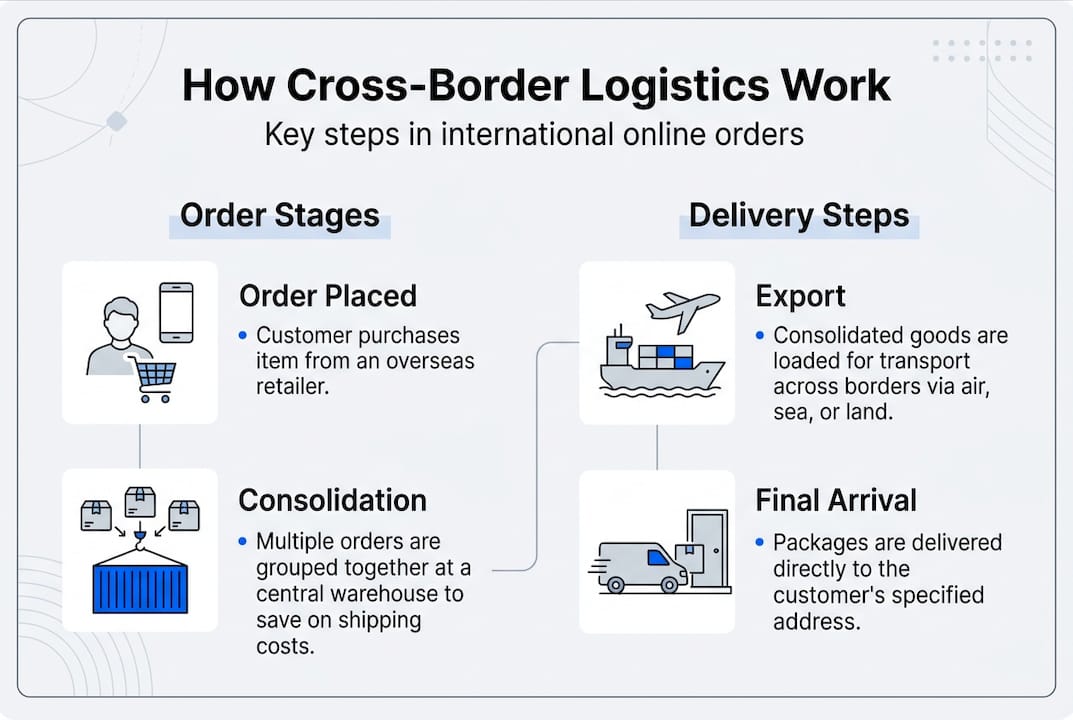
When you place an order on Taobao, Tmall, or Weidian, your item doesn't teleport to your front door. It goes through a carefully structured series of steps, and knowing each one helps you manage expectations and avoid costly mistakes.
Here's the typical journey your package takes:
- Order placed and seller ships domestically: After you confirm your order, the seller ships the item within China to a consolidation warehouse. This domestic leg typically takes 2 to 5 business days.
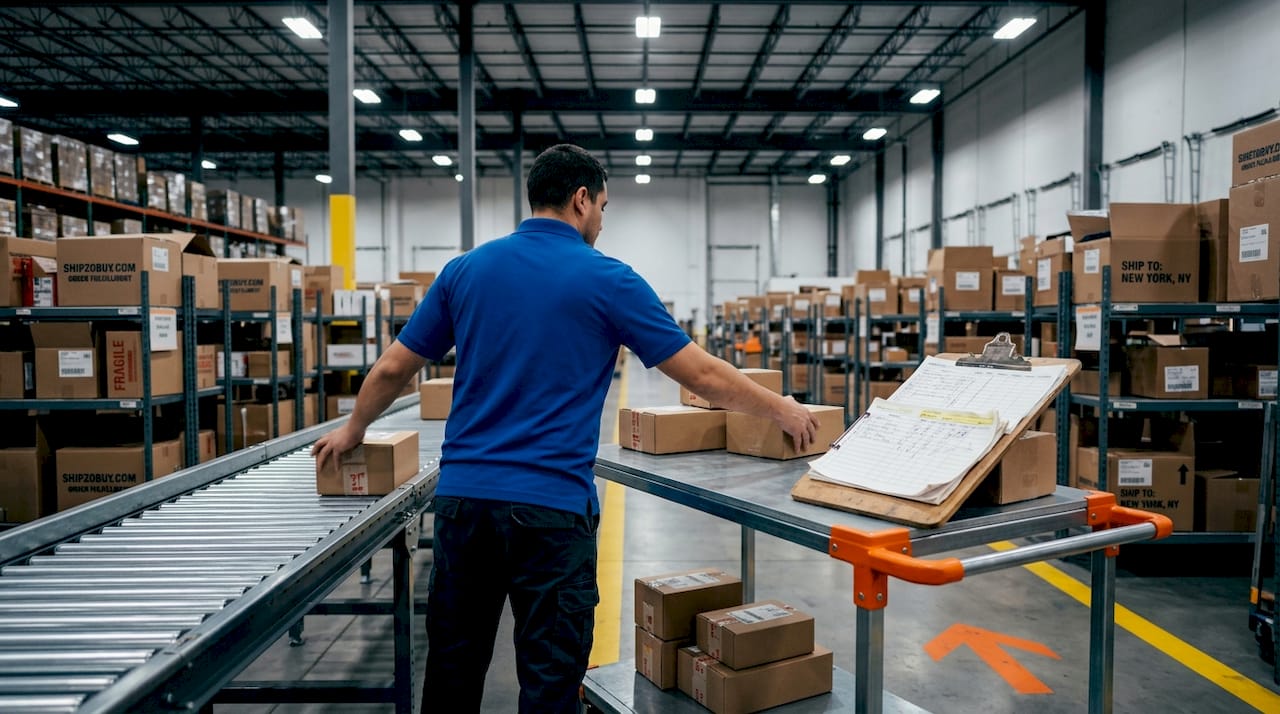
- Arrival at the consolidation warehouse: Your package arrives at a forwarding warehouse, where it's logged, inspected if requested, and stored until you're ready to ship internationally.
- Consolidation: If you've ordered multiple items from different sellers, the warehouse combines them into a single outbound shipment. This is where you save significantly on international shipping costs.
- Outbound international shipping: Your consolidated package is dispatched from China to your destination country via your chosen carrier or shipping line.
- Customs clearance: Your package passes through customs in your destination country. Declared value, product type, and local regulations all affect this stage.
- Last-mile delivery: A local courier delivers the package to your address.
Cross-border shopping from Chinese marketplaces typically relies on consolidated or forwarded logistics flows, which is why understanding the warehouse stage is so critical.
| Stage | Typical timeframe | Key action required |
|---|---|---|
| Domestic shipping to warehouse | 2 to 5 business days | Track via seller's shipping number |
| Warehouse storage | Variable (watch deadlines) | Initiate consolidation before fees apply |
| International shipping | 7 to 20 business days | Choose carrier and service level |
| Customs clearance | 1 to 5 business days | Ensure accurate customs declaration |
| Last-mile delivery | 1 to 3 business days | Monitor local tracking number |
One critical detail that many first-time international shoppers miss: warehouse storage deadlines. Most forwarding warehouses only hold your packages for a set period, often 30 to 90 days. If you don't initiate your outbound shipment before that deadline, you may face storage fees or even have your items returned. Always check the storage policy of your forwarding service before you start shopping.
Pro Tip: Before placing multiple orders across different sellers, confirm that all items will arrive at your warehouse within a similar timeframe. Staggered arrivals can push you past storage deadlines and inflate your overall costs.
Direct shipping, where the seller ships your item straight to your international address without a consolidation step, is also an option. It's faster, usually completing the journey in 5 to 12 business days, but it typically costs significantly more per item and gives you less control over packaging and quality inspection.
Choosing logistics options: Speed, cost, and reliability
Now that you know the logistics steps, let's see how you can make smart choices for shipping your orders.
Every international shopper faces the same three-way tension: you want your order fast, you want to spend as little as possible on shipping, and you want your package to arrive undamaged and trackable. The challenge is that optimizing for all three simultaneously is rarely possible. Understanding the trade-offs is what separates smart shoppers from frustrated ones.
Here's a direct comparison of the two main approaches:
| Factor | Direct shipping | Consolidated shipping |
|---|---|---|
| Speed | Faster (5 to 12 business days) | Slower (10 to 25 business days) |
| Cost per item | Higher | Lower |
| Tracking visibility | Variable | Generally better |
| Packaging control | Seller-dependent | Warehouse-controlled |
| Quality inspection | Not available | Available on request |
| Best for | Single, urgent purchases | Multiple items or bulk orders |
Consolidation reduces cost per item and improves control, making it the preferred choice for shoppers who plan their purchases strategically rather than buying impulsively. If you're shopping for a full wardrobe refresh from multiple Taobao sellers, consolidating everything into one shipment can cut your shipping costs by 40 to 60 percent compared to shipping each item separately.
Platforms like Cainiao, which is Alibaba's logistics arm, have changed the game for international shoppers. Cainiao orchestrates a digital ecosystem for end-to-end movement and tracking, connecting multiple delivery companies, warehouses, and customs offices under a single tracking interface. This means better visibility for you, even when your package crosses multiple carriers across different countries.
Here are the key factors to evaluate when choosing your logistics approach:
- Delivery urgency: If you need an item for a specific event or date, direct shipping may justify the extra cost. For non-urgent purchases, consolidation is almost always the smarter financial choice.
- Order volume: Buying three or more items from different sellers? Consolidation becomes increasingly valuable with each additional item.
- Item fragility: Fragile or high-value items benefit from warehouse inspection and careful repacking before international shipment.
- Destination country: Some countries have faster and more reliable last-mile delivery networks than others. Research your local options before choosing a carrier.
- Carrier tracking quality: Not all carriers provide the same level of tracking detail. Look for services that offer real-time updates through customs and last-mile stages.
Pro Tip: Coordinate with friends or family who also shop from Chinese marketplaces. Pooling your orders into a single consolidated shipment can dramatically reduce the per-item shipping cost for everyone involved, and you only need one person to manage the logistics process.
Logistics as a growth engine: Volume, efficiency, and future trends
Beyond your individual choices, here's how logistics is transforming global e-commerce and driving lower costs and faster deliveries for everyone.
The scale of Chinese e-commerce logistics is genuinely staggering. In 2023, China's express delivery industry handled over 132 billion parcels, powered by e-commerce growth and smart networks. To put that in perspective, that's roughly 17 parcels for every person on Earth, all processed in a single year. This volume isn't just a statistic. It's the engine that drives continuous innovation in warehousing, routing, and delivery technology.
For you as an international shopper, this scale translates into real, tangible benefits:
- Lower shipping rates: High volume creates competitive pricing among carriers, which eventually passes savings to end consumers.
- Better route optimization: Advanced algorithms now calculate the most efficient international shipping routes, reducing transit times even for budget shipping options.
- Improved customs processing: Technology-driven customs declarations and pre-clearance systems are reducing delays at borders worldwide.
- Smarter warehouse automation: Automated sorting and packing systems reduce human error and improve package condition on arrival.
- Real-time tracking advances: AI-powered tracking systems can now predict delivery windows with greater accuracy and proactively alert shoppers to potential delays.
"The future of cross-border logistics isn't just about moving packages faster. It's about making the entire experience so transparent and reliable that international shopping feels no different from buying locally."
Instant retail, the concept of receiving orders within hours rather than days, is already a reality within China's major cities. While true instant delivery for international orders remains years away, the technology being developed for domestic instant retail is gradually being adapted for cross-border logistics. Drone delivery pilots, AI-driven customs pre-clearance, and blockchain-based package authentication are all being tested at scale within China's logistics ecosystem.
For shoppers buying from Taobao, Tmall, or Weidian today, these advances mean you can reasonably expect delivery times and tracking quality to improve meaningfully over the next two to three years. The platforms that invest in logistics infrastructure now are the ones that will win your loyalty in the future.
The key takeaway is that logistics performance has become a measurable competitive advantage for e-commerce platforms, not just a cost center. When a platform consistently delivers on time with full tracking visibility, it earns a premium position in your consideration set, regardless of whether its product prices are the absolute lowest.
The uncomfortable truth about logistics in cross-border shopping
Let's step back for some hard-won lessons about what really makes you a repeat shopper.
Here's something that rarely gets said plainly: even perfect logistics won't save a bad shopping experience. We've seen shoppers receive their orders exactly on time, in pristine condition, with flawless tracking, and still never return to a platform because their one customer service interaction was dismissive or their return request was ignored.
The logistics advantage is necessary but not always sufficient for conversion and repeat purchase. What this means in practice is that logistics is the floor, not the ceiling, of a great cross-border shopping experience. You need it to be solid, but it alone won't build loyalty.
Think about what happens when something goes wrong, because it will at some point. A package gets held in customs longer than expected. An item arrives slightly different from the listing photos. A size runs unexpectedly small. In those moments, what determines whether you remain a loyal customer is not how fast the original delivery was. It's how quickly and fairly the problem gets resolved.
The platforms and services that win long-term are those that treat logistics, customer support, and returns as a unified experience rather than separate functions. Great deals and reliable shipping get you in the door. Clear, responsive help when things go sideways is what keeps you coming back. Treat logistics as one important piece of your shopping decision, but evaluate the full picture before committing to any platform or forwarding service.
Looking for a seamless shipping experience?
Ready to take the worry out of logistics for your international orders? Navigating warehouses, consolidation timelines, and customs declarations is genuinely complex, and even experienced shoppers occasionally miss a deadline or overpay on shipping because they didn't have the right support.
Shipzobuy handles the entire logistics process for your Taobao, Tmall, and Weidian purchases, from product procurement and quality inspection at the warehouse to consolidated international shipping with transparent tracking. You get full visibility into your shipment at every stage, with no hidden fees and no missed storage deadlines. Whether you're shopping for fashion finds or lifestyle products, Shipzobuy makes cross-border buying feel as straightforward as ordering from a local store. Start your next shopping spree with confidence.
Frequently asked questions
What is package consolidation when shopping from China?
Package consolidation combines multiple purchases into one shipment to lower shipping costs and improve tracking and control, making it the most cost-effective option for shoppers buying from multiple sellers.
How long does delivery from Taobao or Tmall typically take?
International shipping takes 7 to 20 business days after consolidation, plus an additional 2 to 5 days for domestic shipping from the seller to the warehouse in China.
Why is tracking important for online shoppers?
Logistics tracking is directly linked to customer trust and repeat purchase intent, providing peace of mind and reducing anxiety about lost or delayed packages during international transit.
Do all marketplaces use the same logistics providers?
No, Cainiao connects multiple delivery companies, warehouses, and customs offices into a digital logistics ecosystem, but logistics partners and available options vary significantly depending on which marketplace you're using.